Active Questions
Begin with six honest answers. Bring attention to happiness, meaning, engagement, relationships and your goals—not just a higher score.
The Telos Method Course
You do not need perfect motivation or a promise to change. Start by answering simple questions about what matters to you. The wider exercises are there to explore at your own pace.
The Telos Method Course is for people who are tired of repeatedly knowing what they should do, intending to do it and then finding themselves back in the same pattern.
You can explore a goal, habit or recurring response that matters to you; you do not need to commit to changing it before you begin. It might be beginning an important work task, making sales calls, following up prospects, writing, studying, walking, exercising, maintaining a useful routine or completing personal or business administration.
“Begin with one thing that matters. Build a practice from there.”
The Telos Method CourseThe four foundations
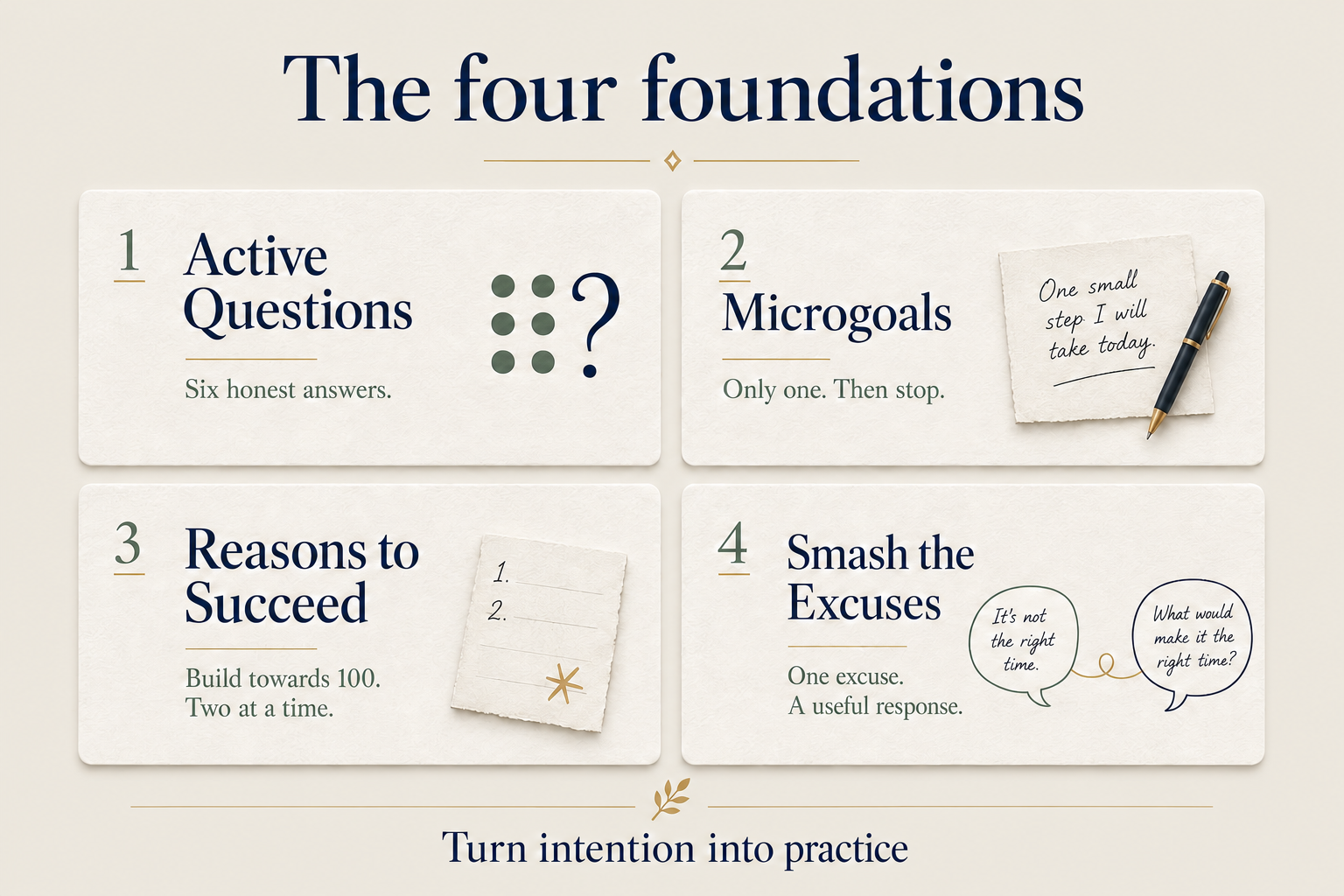
Begin with six honest answers. Bring attention to happiness, meaning, engagement, relationships and your goals—not just a higher score.
One genuinely tiny action. Keep it tiny for the first weeks: do only that one and stop. Habit and confidence come before quantity.
Build towards 100 personally meaningful reasons, two at a sitting. Make the reasons your own.
Write down recurring objections and prepare believable responses that lead back to your reason and tiny action.
A taste of the course
The course is question-based. You build a personal collection of reasons and responses, a little at a time—not an ambitious daily to-do list.
This short worked example shows the type of prompt you will use. You can answer on paper. The full teaching explains how to make your reasons more personally meaningful and your countermeasures believable.
Work towards 100 reasons over time, two at a sitting. The target is a Telos teaching approach, not a research-proven threshold.
Course prompt · Example answer
“I want to write because there is a story I want my children to have. I want to finish something that is mine.”
“I do not have time to write a chapter.”
“If I think I need time for a chapter, then I will remind myself that one sentence is the whole target. I can write one sentence after my morning coffee, then stop.”
A made-up example, not a participant result. Your reasons and wording should be your own.
Course contents
Answer the six daily questions honestly, scoring your effort since you last scored yourself. You can check in more than once a day; a low honest score still completes the exercise.
Research connection: Goldsmith’s ten-day survey: 91% reported improvement in at least one area; self-reported, without a control group. Meet the researchers and read the finding →
Work towards 100 personally meaningful reasons, two at a sitting. Two is the small daily request, not the final target.
Research connection: Prochaska’s research across 12 behaviours connects readiness with the perceived benefits and drawbacks of change. Meet the researchers and read the finding →
Capture recurring excuses and write an effective countermeasure for each: if this thought appears, then this is my response. Reconnect to a reason and a safe tiny action.
Research connection: Experiments on reappraisal and if–then planning support related elements, not a tested Telos success rate. Meet the researchers and read the finding →
Explore the sensory qualities of an ordinary, manageable feeling. Diminish the unwanted qualities, then use the qualities of a positive experience to build a more supportive response.
Research connection: Three small studies found that imagining unpleasant scenes shrinking and moving away generally reduced their emotional impact; the full Telos sequence was not tested. Meet the researchers and read the finding →
Optional focused emotional writing for 10–20 minutes: try one session, or return for further sessions such as a series of three. This is not compulsory daily journalling.
Research connection: A 31-study review found small average symptom reductions following expressive writing, with varied results across research. Meet the researchers and read the finding →
Imagine versions of yourself with more of a desired feeling or energy, then imaginatively step into them or let them join you. This can be done safely while stationary.
Research connection: Related imagery research supports exploring immediate feeling; Telos’s multiple-selves sequence has no verified direct efficacy statistic. Meet the researchers and read the finding →
One press-up, one sentence or one item put away. For the first couple of weeks, do only one and stop—even if you feel like more. Later, a larger amount is optional; one remains a complete, successful fallback.
Research connection: Habit and cue-planning research supports repetition; it does not prove that a tiny action must grow into a bigger routine. Meet the researchers and read the finding →
When you choose Goal Setting, work through its five parts: goals, milestones, direction, metrics and contracts with yourself. Connect them to your reasons, countermeasures and tiny action.
Research connection: A review of 141 papers found a positive average effect of goal setting on behaviour. Meet the researchers and read the finding →
Use positive and negative visualisation to rehearse a goal and prepare for obstacles.
Research connection: A 21-study review supports mental contrasting plus if–then plans; it did not test the complete Telos script. Meet the researchers and read the finding →
The chapter order groups Thoughts, Emotions and Actions; it is not a compulsory week-by-week schedule. Begin with the four foundations. The other five exercises remain part of the full course, but choose which to practise according to what you need—not nine daily tasks.
A foundation-first route
Choose the online course, a two-week guided introduction or a six-week programme with greater depth. In every format, begin with the foundations; you do not have to wait for a particular week to start.
Answer honestly each day, or since your last check-in. You do not need a goal, diary or explanation of your score before starting. The intention is to improve everyday experience and build trust through your own experience.
This can begin during the first couple of weeks with a guide, or after an initial period with the questions when working independently. Once introduced, do only the tiny amount for its first couple of weeks, then stop.
Write two at a sitting. Keep going over time, making them specific and personally meaningful rather than borrowed slogans. The target of 100 is Telos’s teaching approach, not a research-proven threshold.
Write the thoughts that repeatedly stop you. For each, prepare a truthful response and a safe fallback: “If I think I have no time for a chapter, then one sentence is enough.”
Use Goal Setting, Submodalities, Emotion Download, Sensory Affirmations or Visualisation where they serve you. Learn the complete method without making every exercise a daily obligation.
After the initial period, you may choose to do more. One remains a complete success even on a day when the larger target does not happen. A missed day is not a reason for self-criticism or a catch-up task.
Telos is not designed to diagnose or treat depression, anxiety disorders, trauma, eating disorders, addiction, compulsions or medical conditions. It is not therapy or crisis support and should not replace appropriate professional advice.
Why this approach is worth trying
Choose your level of support
The same Telos Method, whether your focus is everyday life, wellbeing, work or sales. You choose the format—not a different system for every goal.
Your first step
Six honest answers, private score graphs and history. Add one optional Microgoal. No paid course required.
Keep practising free beyond the introduction.
Start Daily Questions free →Learn at your pace
Learn all nine exercises through course teaching and workbook prompts. Begin with the four foundations; choose the other exercises to suit you.
£79 one-off · Early-access enquiry. Access and delivery confirmed before payment.
Request online course details →Guided foundations
An initial 2–4-hour session with a guide, followed by simple daily practice. A second teaching session can be included in your agreed package.
Company package: £1,495 for up to 15 people, excluding VAT if applicable. Includes a three-hour opening session.
Explore the two-week programme →Go deeper
More time to learn the wider method, apply the exercises and review what helps. Private sessions for key people can be added.
Live group course: £299 per person. Private and company packages are also available.
Explore the six-week programme →Optional accountability can support the free practice, online course or either guided programme. Ask about reminders, calls and daily 15-minute group check-ins. Prefer reading? Explore the books.
Compare all courses & pricesCourse early access
Learn the complete nine-exercise method and apply it to one chosen behaviour. Register your interest for access and delivery details before deciding. No payment is taken through this form.
Individual Telos interest
Register your interest in the £79 course. We will reply with availability and delivery details before you decide.
Common questions
No. Telos treats motivation as influenced by expectations, priorities, distractions, emotional responses, delays and actions. It gives you exercises and a way to measure what happens.
No. Start by answering the six questions; you do not have to choose a goal or promise to change first. When you choose a microgoal, one tiny action is enough.
Yes, for an ordinary beneficial work or everyday behaviour. Telos does not provide medical, nutritional or clinical advice.
There is no catch-up penalty. Return to the tiny action when it is safe and practical. Even if you later aim for twenty repetitions, one still maintains your chosen practice; genuine health or practical constraints deserve respect.
Maintain your practice
Once you have chosen a behaviour and begun applying the exercises, optional accountability can help you record what happens and decide which part of your plan to revisit.
Explore optional accountabilityReminders, AI or human calls and daily 15-minute group check-ins are optional. Availability, frequency and price are confirmed before booking.
The Telos Method book offers a self-contained route through the nine exercises at your own pace.
Explore the book →Exercise 1 of The Telos Method
Begin with six honest answers about happiness, meaning, engagement, relationships and your goals. Alongside them, choose one optional Microgoal if there is a behaviour you want to begin or return to.
Daily Questions · One optional Microgoal · Your reflections stay private
Daily Questions
Score reasonable effort, not outcomes beyond your control.