Answer all six
Use the same six questions consistently enough to notice the direction of your attention and effort.
Six Daily Questions
No promise to change. No perfect score. Just show up and answer.
Free questions, graphs and history · Access and privacy explained
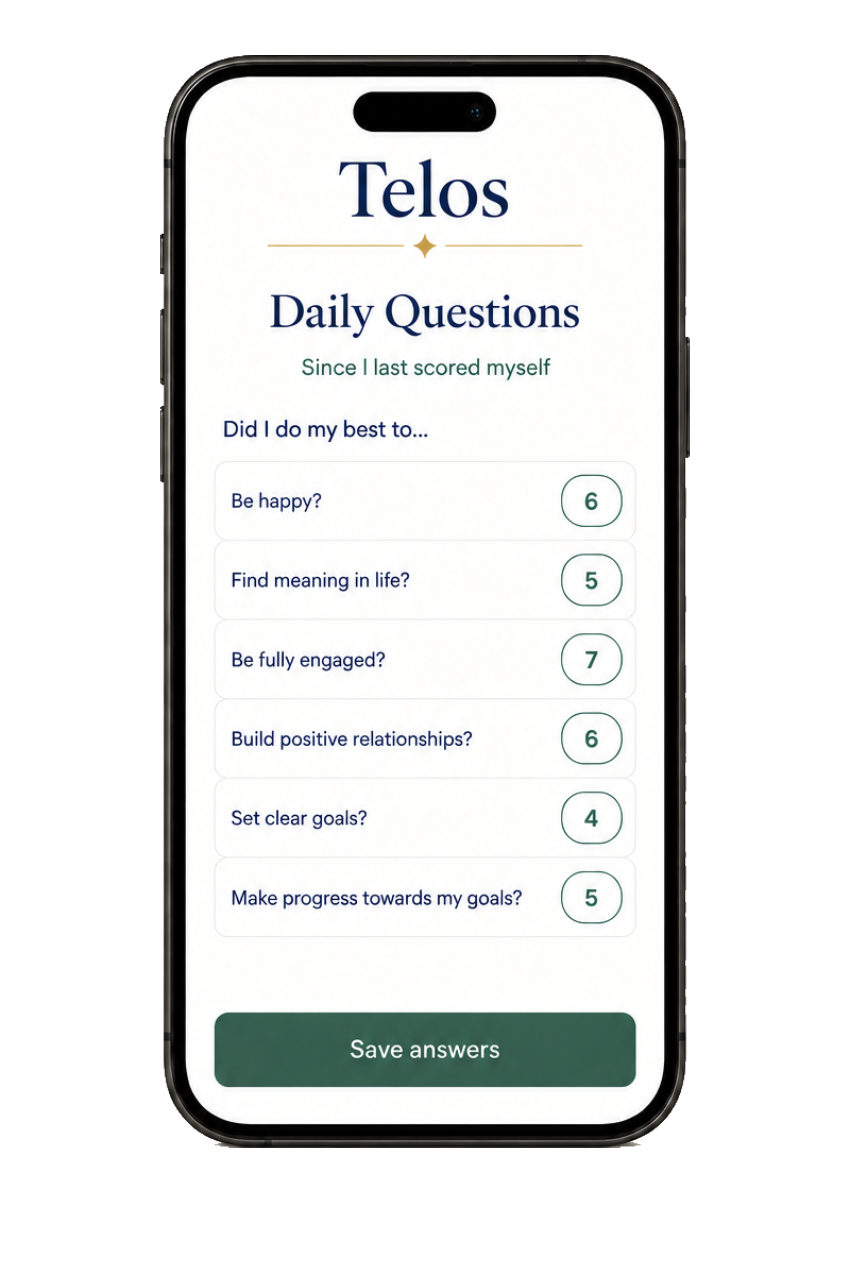
A practice you can keep using
Use the online workbook if you want private graphs of your scores, or print the starter if you prefer pen and paper. You do not need to share personal reflections with Telos. Free access continues beyond the introductory period.
Free Daily Questions starter
Request the printable starter by email. You can also download it directly or keep using the free online workbook.
The problem it addresses
You can make a good effort and receive no immediate result. You can also have a good result on a day when you avoided the work you had intended to do.
Daily Questions bring your attention back to conduct you can influence, rather than making mood or outcome the only judge of the day.
Why this approach is worth trying
The six questions
Answer and score all six questions. Telos uses “since I last scored myself” so each check-in covers the interval since the previous one, whether that is a day or part of a day. It is a flexible practice, not a claim that checking more often works faster.
How to begin
Use the questions for your life as a whole, then add questions about work, sales, exercise, study or another goal if useful.
Use the same six questions consistently enough to notice the direction of your attention and effort.
At the end of the day or activity, score each question from 0 to 10. Score what you did, not what you meant to do. A zero means you made no effort; a ten means you did your best.
If useful, record what helped, what got in the way or what was happening when the score changed. One sentence is enough. This is a tracking note, not the Emotion Download exercise.
At the end of the week
You are not collecting scores for their own sake. You might notice more attention to relationships, clearer priorities or a different response to an ordinary day. There is no required deadline or guaranteed result. If useful, notice which action was repeatedly postponed, when effort was stronger or weaker, and whether the question itself is too large or unclear. A low score is information about what happened between intention and action; it is not a verdict about your character.
Download the printable worksheet“Daily Questions make effort visible.”
The Telos MethodMake it easier to show up
Optional accountability can support both your Daily Questions and your Microgoal. Ask about reminders, AI or human calls, or a daily 15-minute group check-in with a guided programme.
Support is arranged separately. Availability, price, frequency and privacy arrangements are confirmed before booking; nothing here starts a subscription.
Explore accountabilityThe workbook encrypts your entries. If you answer aloud to another person, they can hear those answers; a call is different from private self-entry.
How access, backup and recovery work →Before you begin
No. Start with the six questions. A Microgoal is recommended when you want to add an action, but it is optional.
An honest zero is a completed answer. Scores record effort, not your worth. There is no pass mark and no catch-up task.
Yes. Use “since I last scored myself” so each check-in covers the interval since the previous one, not the whole day again.
No. The six questions, basic graphs and history remain free. Courses and accountability are optional additions.
Choose your level of support
The same Telos Method, whether your focus is everyday life, wellbeing, work or sales. You choose the format—not a different system for every goal.
Your first step
Six honest answers, private score graphs and history. Add one optional Microgoal. No paid course required.
Keep practising free beyond the introduction.
Start Daily Questions free →Learn at your pace
Learn all nine exercises through course teaching and workbook prompts. Begin with the four foundations; choose the other exercises to suit you.
£79 one-off · Early-access enquiry. Access and delivery confirmed before payment.
Request online course details →Guided foundations
An initial 2–4-hour session with a guide, followed by simple daily practice. A second teaching session can be included in your agreed package.
Company package: £1,495 for up to 15 people, excluding VAT if applicable. Includes a three-hour opening session.
Explore the two-week programme →Go deeper
More time to learn the wider method, apply the exercises and review what helps. Private sessions for key people can be added.
Live group course: £299 per person. Private and company packages are also available.
Explore the six-week programme →Optional accountability can support the free practice, online course or either guided programme. Ask about reminders, calls and daily 15-minute group check-ins. Prefer reading? Explore the books.
Compare all courses & pricesContinue with the method
A Microgoal gives you one deliberately easy action to complete alongside your questions. The wider course then helps you build your reasons, prepare for excuses and choose the exercises that serve you.